
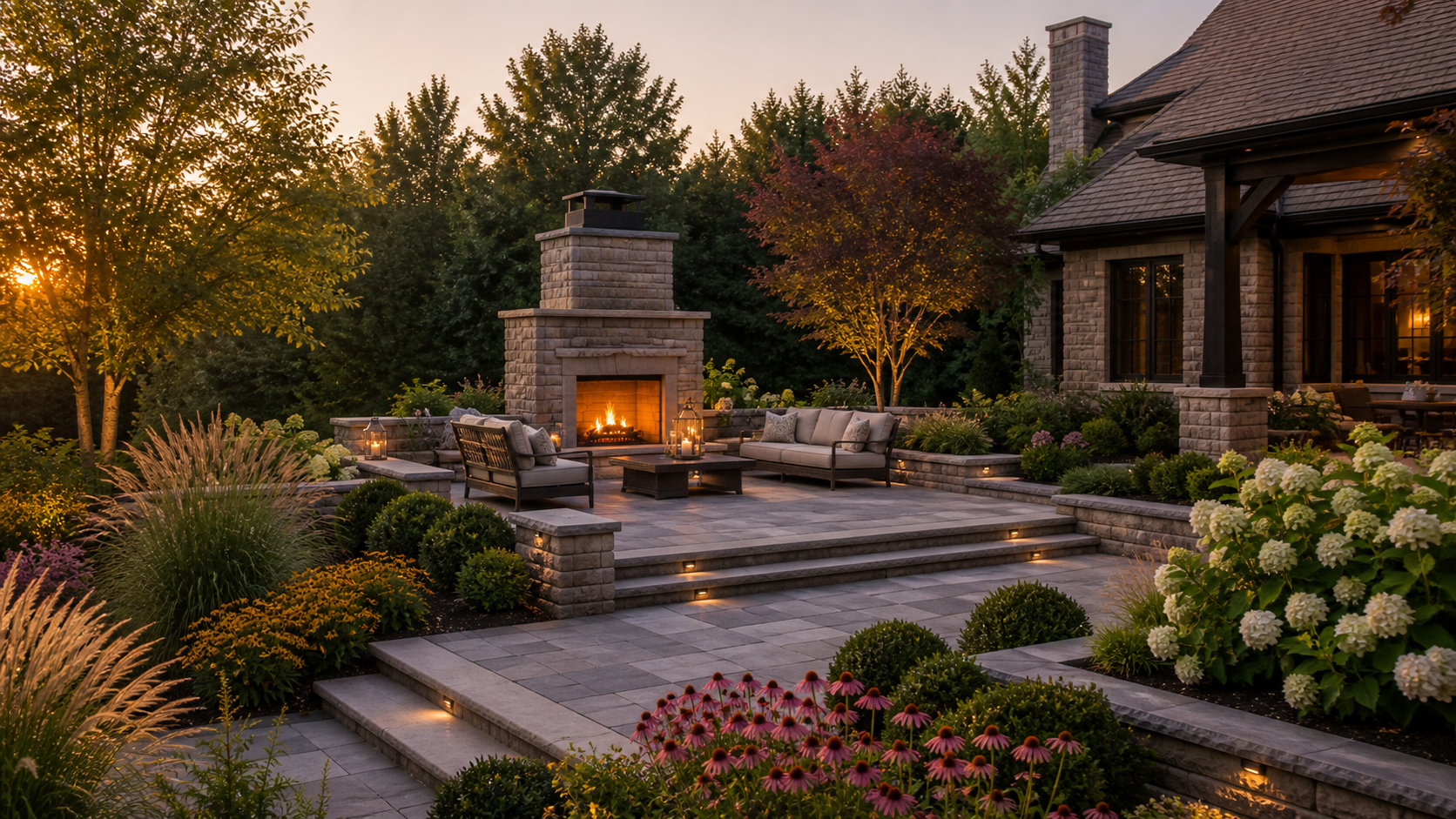
Fire changes how people use a backyard. It gives the evening a destination and creates a natural reason to stay outside after dinner.
The more important design decision is what kind of fire experience you want.
A fire pit encourages people to gather around all sides. An outdoor fireplace creates a strong focal point and a more defined outdoor room. Neither is automatically better. They support different kinds of spaces.
For a high-end outdoor living project, the choice should be based on seating, views, privacy, architecture and how the rest of the backyard is organized.
Fire pit vs. outdoor fireplace at a glance
| Feature | Fire pit | Outdoor fireplace |
|---|---|---|
| Seating | Usually 360 degrees | Primarily faces one direction |
| Social feel | Casual, conversational | More room-like and architectural |
| Visual impact | Strong at close range | Strong from across the yard and from inside |
| Privacy | Limited by itself | Can create a substantial visual screen |
| Footprint | Can require wide seating circle | Can use a narrower linear zone |
| Wind/smoke | Exposed on all sides | Chimney and orientation can influence experience |
Choose a fire pit when conversation is the priority
A fire pit naturally brings people into a circle.
That makes it particularly effective for families and homeowners who host groups. Everyone can see one another, and the fire sits at the center of the conversation rather than becoming a backdrop.
A custom fire-pit area can be much more refined than a round bowl placed on a patio. It may include:
- A dedicated paver terrace
- Built-in seat walls
- Natural-stone surround
- A linear or rectangular fire table
- Integrated landscape lighting
- Planting that creates privacy
- A slightly sunken lounge area
The geometry does not have to be circular. Rectangular and linear fire features can work beautifully in contemporary spaces while preserving the social benefit of seating around multiple sides.
Choose an outdoor fireplace when you want architecture
An outdoor fireplace creates a vertical element that can anchor the entire backyard.
It can frame a view, terminate a patio axis or provide the visual weight needed at the end of a large terrace. A fireplace can also make a lounge feel like an actual room because it creates a clear front wall.
This is useful when the backyard feels open or lacks a focal point.
A fireplace may be constructed with natural stone, masonry veneer or materials that repeat those used on the house. Mantels, hearths, wood storage and adjacent seat walls can make it more substantial.
At night, carefully placed lighting can reveal stone texture without competing with the fire itself.
See D2’s fire feature design and installation for more information.
Think about the view from inside the house
An outdoor fireplace often has an advantage when the goal is to create a focal point that can be enjoyed year-round.
From a kitchen or family-room window, a fireplace provides form even when it is not lit. Add planting and low-level lighting and it can remain one of the strongest views on the property throughout winter.
A fire pit is usually lower and therefore less visually dominant from inside. That may be preferable if the backyard has an existing view you do not want to block.
Consider privacy
A fireplace can do two jobs at once.
If a seating area is exposed to a neighboring property, the fireplace mass can block a sightline while also creating the room’s focal point. It can be combined with planting or partial walls for a layered privacy strategy.
A fire pit leaves the space more open. If privacy is needed, it may rely more heavily on landscape design, pergola screens or surrounding walls.
For more ideas, see D2’s privacy landscape design.
Think about wind before deciding where fire goes
Fire placement should not be based only on the most convenient empty corner of a patio.
Study prevailing wind, nearby structures, trees and where people will sit. Smoke from a wood-burning feature can make an otherwise beautiful lounge difficult to use if the location is wrong.
Gas fire features simplify some aspects of operation, but placement and manufacturer clearances still matter.
Gas or wood?
This decision is partly about atmosphere and partly about convenience.
Wood provides sound, aroma and the ritual of building a fire. It also brings smoke, ash, fuel storage and more cleanup.
Gas provides immediate ignition and easier control. That convenience can make a fire feature more likely to be used on an ordinary weeknight rather than only for special occasions.
For many luxury outdoor spaces, frequent use is more valuable than theoretical authenticity. The best fuel source is the one that fits how the homeowner wants to live.
How much space does a fire feature need?
The feature itself is only part of the footprint. Seating and circulation usually require more space.
A generous fire-pit lounge needs room for chairs or built-in seating, side tables and movement around the group. A fireplace lounge needs enough depth for furniture without pushing the main circulation path through the seating area.
This is why the fire zone should be placed on the plan before the patio is finalized.
Pair fire with the right surrounding materials
Fire features are natural focal points, so material choices carry more weight.
Natural stone can create a timeless, substantial fireplace. Smooth masonry and linear fire elements can suit modern architecture. Paver seat walls and patios can visually connect the lounge to the rest of the hardscape.
There is no need to introduce a new material simply to make the fire area special. Often it feels more custom when the same palette is used in a more detailed way.
Fire features in Cincinnati and Northern Kentucky backyards
A fire feature can significantly extend how long a patio feels inviting during spring and fall.
In larger suburban backyards such as Mason or Union, a separate fire lounge can help break a broad yard into distinct destinations. On established properties in Villa Hills, the fire feature may be more closely integrated with a terrace, retaining wall or privacy plan.
The site determines the right expression.
D2’s designer’s take
If your family loves conversation and wants flexible social seating, begin by exploring a fire pit or fire table.
If you want the backyard to feel more architectural, need to create a focal wall or want to screen a view, an outdoor fireplace often provides more design value.
In many cases, the answer becomes obvious once the overall backyard is masterplanned.
D2 can coordinate fire features, paver patios, retaining walls, landscape design and lighting as one complete outdoor environment.
Frequently Asked Questions
Is an outdoor fireplace better than a fire pit?
An outdoor fireplace is better when a strong architectural focal point, one-direction seating or privacy is important. A fire pit is often better for circular conversation and a more open social setting.
Which takes up more space, a fire pit or fireplace?
A fire pit may require more total width because seating often surrounds it on multiple sides. A fireplace has a larger vertical structure but can work with a more linear seating arrangement.
Is gas or wood better for an outdoor fire feature?
Gas is convenient, clean and easy to use frequently. Wood offers a traditional fire experience with sound and aroma but requires fuel storage, cleanup and smoke management.
Can a fire feature be added to an existing patio?
Sometimes. The feasibility depends on patio size, construction, clearances, fuel source, utilities and surrounding materials. A site evaluation is important before deciding on the location.
Can an outdoor fireplace help with privacy?
Yes. Its vertical mass can block a specific sightline and make a lounge feel more enclosed. It can be combined with planting or walls for additional privacy.
Should lighting be installed around a fire feature?
Yes, but it should be subtle. Step lights, wall lights and landscape lighting beyond the fire zone can improve safety and depth without overpowering the firelight.
Ready to upgrade your outdoor space?
If you want an outdoor space that’s designed for how you live—built with materials that hold up, and finished with details that look right—let’s talk. Schedule your luxury design meeting today – there’s no cost or obligation.