
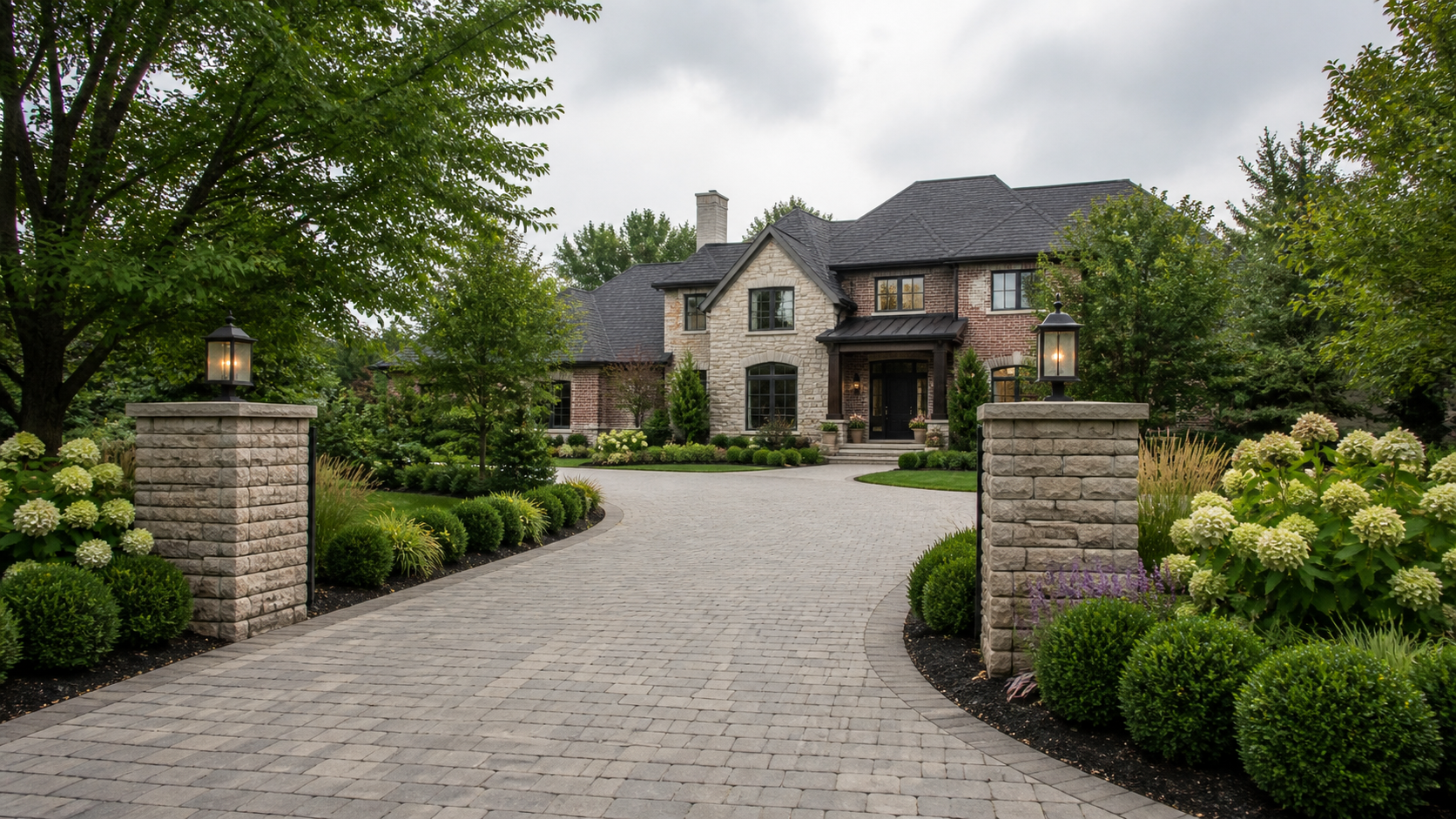
The driveway is one of the largest surfaces on a property. On an upscale home, it should be considered part of the architecture and landscape, not simply a route from the street to the garage.
Both concrete and pavers can create a refined driveway. The better choice depends on the home, the site and the type of experience you want to create when someone arrives.
Concrete can be exceptionally clean and architectural. Pavers offer pattern, color, texture and the ability to build borders, aprons and motor-court details into the surface itself. Neither material is automatically more luxurious. What matters is how well the driveway is designed and built.
Paver driveway vs. concrete driveway at a glance
| Consideration | Paver driveway | Concrete driveway |
|---|---|---|
| Design flexibility | Very high | High when joints, finishes and geometry are intentional |
| Repairability | Individual units can often be lifted and reset | Repairs may be more visible |
| Architectural character | Patterned, detailed, highly customizable | Clean, broad and restrained |
| Winter maintenance | Performs well with appropriate materials and care | Performs well when properly installed and maintained |
| Upfront investment | Typically higher | Often lower than premium pavers |
| Best fit | Custom homes, estate entries, motor courts, detailed designs | Modern, transitional and large clean driveway surfaces |
Where paver driveways stand out
Pavers are particularly effective when the driveway is meant to make an impression.
Borders can echo stone used on the home. A different pattern can define a parking court. The driveway apron can become a deliberate transition from the street. Walkways and front steps can be coordinated with the same material palette.
For estate-style properties, the ability to shape a circular drive, motor court or broad arrival area with intentional pattern and edge details can make the driveway feel like landscape architecture rather than paving.
Pavers are also repairable in a way large concrete slabs are not. If underground work is needed or a small area settles, the affected units can often be lifted, the base corrected and the pavers reset.
That advantage depends on a strong installation. Vehicle loads demand proper excavation, base construction, compaction and edge restraint.
Where concrete makes sense
Concrete works especially well when the architecture calls for simplicity.
A broad concrete drive with carefully placed joints and clean edges can complement modern, transitional and contemporary homes beautifully. It can also provide a visual pause when the house already has stone, brick, metal and extensive landscape detail.
For a high-end project, the joint pattern should be treated as part of the design. Random cuts made only to satisfy construction requirements can make the driveway look utilitarian. When joint locations align with garage bays, walkways, columns or landscape elements, concrete feels more architectural.
D2’s concrete services include driveways, walks, slabs and flatwork that can be coordinated with the larger property design.
What about a combination of pavers and concrete?
Mixed-material driveways can be extremely effective when the materials have clear roles.
Examples include:
- Concrete field with a paver border
- Concrete driveway with a paver apron
- Paver motor court connected to a concrete drive
- Natural stone or cobblestone accent bands
- Paver walkway integrated into a concrete approach
The key is restraint. If every section changes color, pattern and material, the driveway begins to look busy.
One or two purposeful transitions usually feel more sophisticated.
Winter and freeze-thaw considerations
Cincinnati and Northern Kentucky experience repeated freeze-thaw cycles. Water management therefore matters regardless of the surface.
A driveway needs:
- Proper base preparation
- Positive drainage
- Appropriate surface slope
- Stable edges
- Thoughtful snow and ice management
Salt and deicing chemicals should also be considered when selecting and maintaining the surface.
If a heated driveway is part of the plan, that should be coordinated before construction. Snow-melt systems can be incorporated beneath both appropriate paver and concrete systems when designed correctly.
Think beyond the driveway surface
A high-end driveway does not stop at the pavement.
The arrival experience may also include:
- Entry columns
- Landscape lighting
- Address monuments
- Stone walls
- Planting
- Drainage
- Walkways
- Front steps
- Courtyard or motor-court landscaping
This is where a complete design approach makes a significant difference.
On larger properties in Indian Hill or Montgomery, the driveway can be one of the dominant landscape elements. In Hyde Park or Mariemont, scale and architectural compatibility may be more important than sheer size.
Which one has better curb appeal?
Either can.
Pavers naturally provide more visual detail. Concrete naturally provides a cleaner field.
The better surface is the one that supports the home’s architecture.
A traditional stone or brick home may benefit from a paver border or textured driveway surface. A modern home may look better with simple concrete geometry and carefully selected landscape accents.
The mistake is choosing a driveway material independently of the house.
D2’s designer’s take
For a substantial driveway project, start with the arrival experience rather than the square footage.
What should someone see as they approach the home? How should the driveway relate to the front walk? Where does the landscape frame the view? Does lighting make the property feel equally considered at night?
Those decisions are what move a driveway from functional paving to custom exterior design.
Explore D2’s hardscaping services, concrete services and outdoor lighting design for a coordinated approach.
Frequently Asked Questions
Are pavers better than concrete for a driveway?
Not universally. Pavers offer more pattern options and easier sectional repairs, while concrete provides broad clean surfaces and can be very architectural. The right choice depends on the home and design goals.
Are paver driveways strong enough for vehicles?
Yes, when the paver system is designed and installed for vehicle loads with proper excavation, base preparation, compaction and edge restraint.
Which driveway is easier to repair?
Pavers generally allow localized repairs more easily because individual units can be removed and reset. Concrete repairs may be more visible.
Which driveway looks more luxurious?
Both can look high-end. Pavers create detail and texture, while concrete can create a clean architectural look. Luxury comes from the overall design and craftsmanship.
Can pavers and concrete be combined in one driveway?
Yes. Paver borders, aprons and motor courts can be combined with concrete when the material palette is restrained and intentional.
Should a driveway be designed with the landscape?
Yes. Walkways, planting, lighting, walls and drainage should be coordinated with the driveway so the front of the property feels cohesive.
Ready to upgrade your outdoor space?
If you want an outdoor space that’s designed for how you live—built with materials that hold up, and finished with details that look right—let’s talk. Schedule your luxury design meeting today – there’s no cost or obligation.